


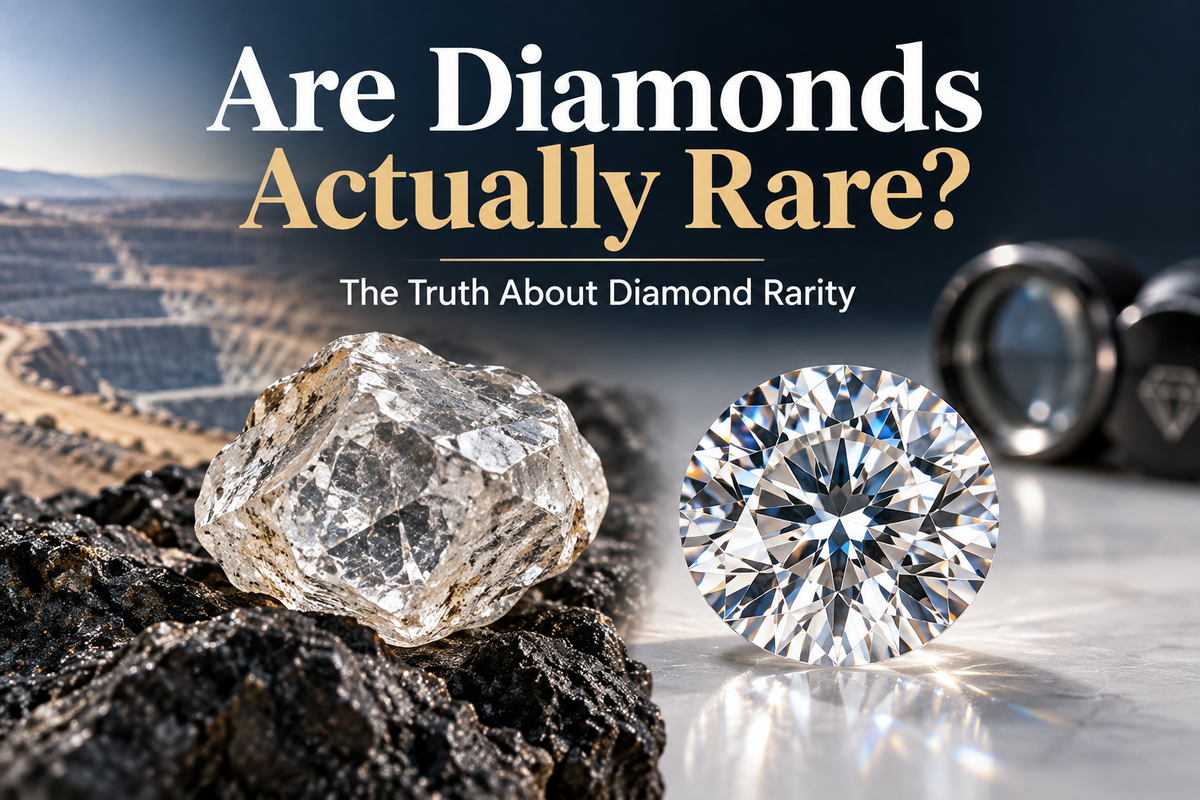
Are Diamonds Actually Rare?
Yes, natural diamonds are relatively rare as a mineral, but not every diamond is equally rare. Diamonds are present in commercially viable numbers due to the advancement in mining technology that allows their extraction on a global scale. Nevertheless, finding a natural diamond that possesses great size, color, clarity, and quality is not an easy task at all.
This becomes crucial when discussing the question, “Are diamonds rare?” A commercially sized diamond and a large-sized perfect natural colored diamond cannot both be considered equally rare.
To comprehend the rarity of diamonds, one needs to consider diamond formation, diamond mining, and diamond properties that make them hard to locate.
What Makes a Diamond Rare?
Diamond rarity can mean several different things.
A diamond may be rare because:
- Natural diamonds form under unusual geological conditions.
- Not all geological formations can produce diamonds.
- Only some of the mined diamonds are used for jewelry.
- Large diamonds are rarer than small diamonds.
- High-clarity diamonds are difficult to find.
- Truly colorless diamonds are scarce.
- Naturally occurring fancy-color diamonds can be exceptionally rare.
- The combination of several desirable characteristics can be extremely uncommon.
Gemological Institute of America (GIA) says that the value of diamonds depends on how rare its features are, and there are four C’s involved, namely color, clarity, cut, and carat weight.
So, rather than asking whether every diamond is rare, a better question is:
How rare is a particular natural diamond compared with other diamonds?
How Are Natural Diamonds Formed?

The unusual characteristic of a natural diamond is its formation process.
Diamonds are formed in extreme heat and pressure within the Earth's crust. According to the GIA, a diamond is formed at a depth of about 100 miles below the Earth's crust, where the right conditions make it possible for carbon atoms to take the form of diamond.
Most natural diamonds are very old. Many were formed billions of years ago before being moved to the Earth's surface.
Diamonds are commonly found in kimberlite pipes, remnants of ancient volcanic activity that brought diamond-bearing material from deep within Earth toward the surface.
This does not mean that every diamond crystal is impossibly difficult to find. Instead, it shows why diamonds are not minerals that simply occur everywhere in accessible concentrations.
Natural diamonds begin as crystals formed deep within the Earth before being brought closer to the surface through geological processes. For readers interested in the material before it becomes a polished gemstone, explore natural rough diamonds.
Are Natural Diamonds Rare or Just Carefully Supplied?
This is where the diamond-rarity issue gets much more difficult.
Natural diamonds are not so rare as to exist in just a few pieces. Decades of large-scale mining have made diamonds available in abundance at jewelry shops.
Geological rarity and availability in the marketplace are not one and the same.
A mineral can be rare in nature but also available to consumers, as:
- Deposits have been found and mined.
- Improved mining technology.
- Diamonds are now available to all through distribution networks around the world.
- Previously mined diamonds can remain in circulation.
- Different grades of diamonds serve different markets.
GIA describes diamond as a relatively rare mineral in nature and notes that only a fraction of known kimberlite and related mantle-sourced rocks have the characteristics needed for economically viable diamond mining.
Therefore, seeing diamonds regularly in jewelry does not necessarily mean that diamonds are abundant throughout Earth's crust.
How Many Diamonds Are Mined Each Year?

Diamond production changes from year to year depending on mine output, economics, operating conditions, demand, and individual mine life.
For this reason, a single annual production number should not be treated as a permanent measure of diamond abundance.
More importantly, the number of diamonds mined does not tell the whole story about rarity.
Thousands or millions of carats of diamonds can be produced while only a small proportion meet particularly demanding combinations of size, color and clarity.
For example, GIA states that approximately 200–250 tons of ore may need to be processed to recover a single one-carat gem-quality diamond, and estimates that only about 20–30% of diamonds found in kimberlite pipes are gem quality.
That helps explain why the term “diamond” covers a much broader range of material than the exceptional stones people see at major auctions or high-end jewelry houses.
Diamonds are also used in forms beyond conventional gemstones, including specialized materials such as diamond beads.
Why Do Diamonds Feel Common If They Are Rare?
If natural diamonds are relatively rare, why do they seem so common?
The answer is largely visibility and market segmentation.
Consumers usually encounter polished diamonds rather than raw diamond-bearing ore. By the time a diamond reaches a jewelry store, it has already passed through mining, sorting, cutting, polishing, grading and distribution.
In addition, not every diamond has the same quality.
Commercial jewelry contains diamonds across a very broad spectrum of:
- Carat weights
- Colors
- Clarity grades
- Cuts
- Shapes
- Origins
- Quality levels
This means that seeing many diamond rings does not mean that every ring contains a particularly rare diamond.
The diamond market makes a relatively unusual natural mineral accessible in many different quality levels.
Are Gem-Quality Diamonds Actually Rare?

Yes. Gem-quality diamonds are considerably more selective than diamond-bearing material in general.
A rough diamond must have characteristics that allow it to produce an attractive polished gemstone. Some crystals are unsuitable for conventional jewelry because of their shape, inclusions, color or other characteristics.
Even among gem-quality diamonds, rarity varies considerably.
A diamond with moderate clarity and visible color is much more readily encountered than an exceptionally clean, highly colorless stone of substantial size.
GIA notes that rarity is directly connected with diamond quality. Its grading system evaluates the four Cs: color, clarity, cut and carat weight.
This is why two diamonds of the same weight can have dramatically different prices.
Diamond material that is unsuitable for conventional gemstone use can also have other applications, including products made from diamond dust.
Are Large Diamonds Rare?

Yes. Large natural diamonds are quite rare compared to smaller diamonds of similar quality.
This is one of the clearest examples of how diamond rarity works.
Imagine two diamonds with similar color, clarity and cut. One weighs 0.50 carat and another weighs 2 carats. The larger diamond is not simply four times as valuable because it weighs four times as much.
Large diamonds are less common, so their rarity can increase their value disproportionately. At the opposite end of the size spectrum, melee diamonds are small diamonds commonly used as accent stones in jewelry designs.
GIA specifically notes that large diamonds are more rare than small diamonds and that larger stones of comparable quality can command substantially higher prices per carat.
When a large diamond also has excellent color and clarity, the combination becomes considerably more unusual.
Are Fancy Color Diamonds Rare?

Some natural fancy-color diamonds are among the rarest diamonds in the world.
Diamonds can occur naturally in colors such as:
- Pink
- Blue
- Red
- Green
- Yellow
- Orange
- Brown
Color rarity varies significantly between categories and individual stones.
For example, naturally occurring red diamonds are exceptionally uncommon, while some other colored diamonds are found more frequently.
The important distinction is between naturally occurring color and color that has been introduced or enhanced through treatment.
Another distinctive category is salt and pepper diamonds, which are known for their unique combination of visible inclusions and natural character.
A natural diamond displaying a highly unusual color can therefore represent a much rarer geological occurrence than an ordinary commercial diamond.
Are Lab-Grown Diamonds Rare?

As far as scarcity is concerned, lab-grown diamonds should be treated separately from natural diamonds.
A lab-grown diamond is created through technological means as opposed to the creation of a natural diamond within the layers of the earth after millions of years. It is quite possible that both lab-grown and natural diamonds have similar chemical and physical properties.
This difference is important.
Natural diamond rarity is based on geological formation and naturally occurring supply. Lab-grown diamond availability is primarily determined by manufacturing capacity and technology.
This does not mean lab-grown diamonds are “fake.” They are diamonds, but they are not naturally mined diamonds.
For someone specifically interested in geological rarity, a natural diamond and a lab-grown diamond therefore represent two very different things.
Are Diamonds Rarer Than Gold?
There is no simple answer because “rarer” can be measured in different ways.
You could compare:
- Geological occurrence
- Mineable deposits
- Annual production
- Concentration in Earth's crust
- Market availability
- Quantity already extracted
- Quality suitable for specific uses
Simply saying “diamonds are rarer than gold” without defining the comparison can therefore be misleading.
Diamonds and gold are also produced and distributed through completely different geological and mining systems.
The better conclusion is that natural diamonds are relatively rare minerals, but the rarity of an individual diamond depends heavily on its characteristics.
A common commercial diamond should not be compared directly with an exceptional natural diamond when discussing scarcity.
Does Rarity Make Diamonds Valuable?
Rare is valuable, but rareness in itself does not equate to diamond value.
Factors that may affect the value of a diamond include:
- Color
- Clarity
- Cut
- Carat weight
- Shape
- Certification
- Market demand
- Provenance
- Natural color
- Overall appearance
According to GIA, rarity is just one aspect that affects a gemstone's value, and it talks about how the qualities depicted by the 4Cs affect the value of a diamond.
For instance, a huge diamond with poor appearance does not necessarily mean that it will be more valuable compared to a small diamond with perfect color and clarity and cut.
What Are the Rarest Types of Diamonds?

There are some kinds that are particularly hard to discover in nature.
Natural Red Diamonds
One such kind is red diamonds, which are very rare in nature. It is due to the rarity and unique color of these diamonds that they have become favorites for collecting.
Exceptional Pink Diamonds
Pink diamonds that have high quality can also be very rare. This has been highlighted by the shutting down of the Argyle mine in Australia.
Natural Blue Diamonds
Blue diamonds are another rare category, with their color associated with specific geological characteristics.
Large, High-Quality Diamonds
A large diamond becomes considerably more unusual when it also has excellent color and clarity.
Rare Combinations of Characteristics
Perhaps the most important category is not any specific color or size but the combination of many great features.
Large, naturally colored, high clarity diamonds with good cuts are extremely rare compared to average diamonds.
Natural Diamonds vs. Lab-Grown Diamonds
|
Factor |
Natural Diamonds |
Lab-Grown Diamonds |
|
Formation |
Form naturally within Earth |
Created using technological processes |
|
Geological rarity |
Naturally scarce |
Not naturally scarce in the same sense |
|
Chemical composition |
Diamond |
Diamond |
|
Crystal structure |
Diamond crystal structure |
Diamond crystal structure |
|
Availability |
Depends on mining and natural deposits |
Depends largely on production capacity |
|
Geological history |
Often extremely old |
Created in a controlled production environment |
|
Rarity discussion |
Based on natural occurrence and quality |
Based more on manufacturing and market factors |
The key takeaway is that chemical similarity does not make natural and lab-grown diamonds equally rare.
If you want to explore natural diamonds and different diamond categories, visit Black Diamond to browse the collection.
So, Are Diamonds Actually Rare? What the Evidence Shows
The correct answer would be yes, but with an important qualification.
Diamonds found in nature are geologically speaking rather rare. The fact is that diamond deposits are not evenly spread across the globe, and only a small proportion of discovered potential deposits are worth mining commercially.
However, this does not mean that all diamonds are rare.
Commercially available diamonds could be much less unique than those that are particularly large, colorless, and clear. Some natural diamonds with fancy coloration could be even more unique.
It is therefore better to say:
Some high-quality natural diamonds that feature exceptional size, color, or clarity could be rare.
This is also the reason why the price of diamonds could not be easily calculated in terms of rarity alone.
Frequently Asked Questions
Are diamonds actually rare?
The natural diamonds are quite rare mineral but the degree of rarity differs widely depending on a particular diamond. There are many commercial-grade diamonds but there can be some very rare diamonds that are big and have an excellent quality along with having natural colors. Geological occurrences, quality, and size make a natural diamond rare.
Are natural diamonds rare?
Yes, the natural diamonds need specific geological conditions for formation and deposits for mining. But natural diamonds have a wide variety of quality so not every natural diamond is extremely rare.
Why are diamonds considered rare?
The diamonds need unusual geological conditions for their creation and there are limited number of deposits for mining. The rarity is increased even more due to factors such as size, clarity, being colorless, or having a natural color.
Are diamonds rarer than gold?
The answer will differ depending on how rarity is quantified. Geological presence, mineralization, annual output, and availability may yield differing results. It is thus inaccurate to say that diamonds are always more rare than gold.
Are large diamonds rare?
Yes. Larger diamonds are very much more uncommon than smaller diamonds of the same grade. Rarity tends to increase as the size becomes larger, especially for those with excellent color and clarity.
Are lab-grown diamonds rare?
Unlike natural diamonds which are geographically rare, lab-created diamonds are not geographically rare since they are grown in laboratories through the use of technology and are not mined from any naturally occurring deposit.
What is the rarest type of diamond?
It is difficult to say definitively which are the rarest diamonds without knowing which definition of "rarest" one might be using, but naturally-occuring red diamonds, particularly rare pink and blue diamonds, and large natural diamonds are among the rarer types.
Why are diamonds expensive if they are not extremely rare?
The cost of diamonds is not only dependent on their rarity. Factors like quality, size, color, cut, and many more may have an impact on the cost of diamonds. A combination of very few features makes a certain diamond more expensive than others.
Does diamond rarity determine its value?
Although rarity plays an essential role, it does not define the cost alone. Color, cut, carat weight, and clarity form the four C’s that define the features of a diamond.




Leave a comment
This site is protected by hCaptcha and the hCaptcha Privacy Policy and Terms of Service apply.