

A complete guide to ring symbolism across cultures, from the thumb to the pinky, and what wearing a ring on each finger traditionally communicates
Even before rings were popular fashion accessories, there was more significance behind wearing them. Since time immemorial and all over the world, the finger upon which a ring is worn serves to convey messages such as marital status, social standing, personal beliefs, and even spiritual protection. Even now, despite the prevalence of selecting jewelry for aesthetic reasons only, many of the meanings of rings have remained relevant and influential.
This guide examines each finger and the traditional significance attached to wearing a ring on each finger, as well as how this meaning developed, and what factors you should take into account when choosing rings.
Why Finger Placement Has Meaning at All
This concept that each finger holds a special meaning does not come out of the blue – it has been a part of various cultures, religions, and even medical beliefs for many centuries. Egyptians, Greeks, and Romans have also believed that certain fingers hold special meanings, based on their misconceptions concerning the human body structure and the traditions associated with marriage, power, and status.
Later on, the meanings of certain fingers became a part of tradition rather than biology, and that is why they remain until now despite the fact that some explanations, such as the existence of a vein connected directly to the heart in the ring finger, have been proven wrong long ago.
The Thumb

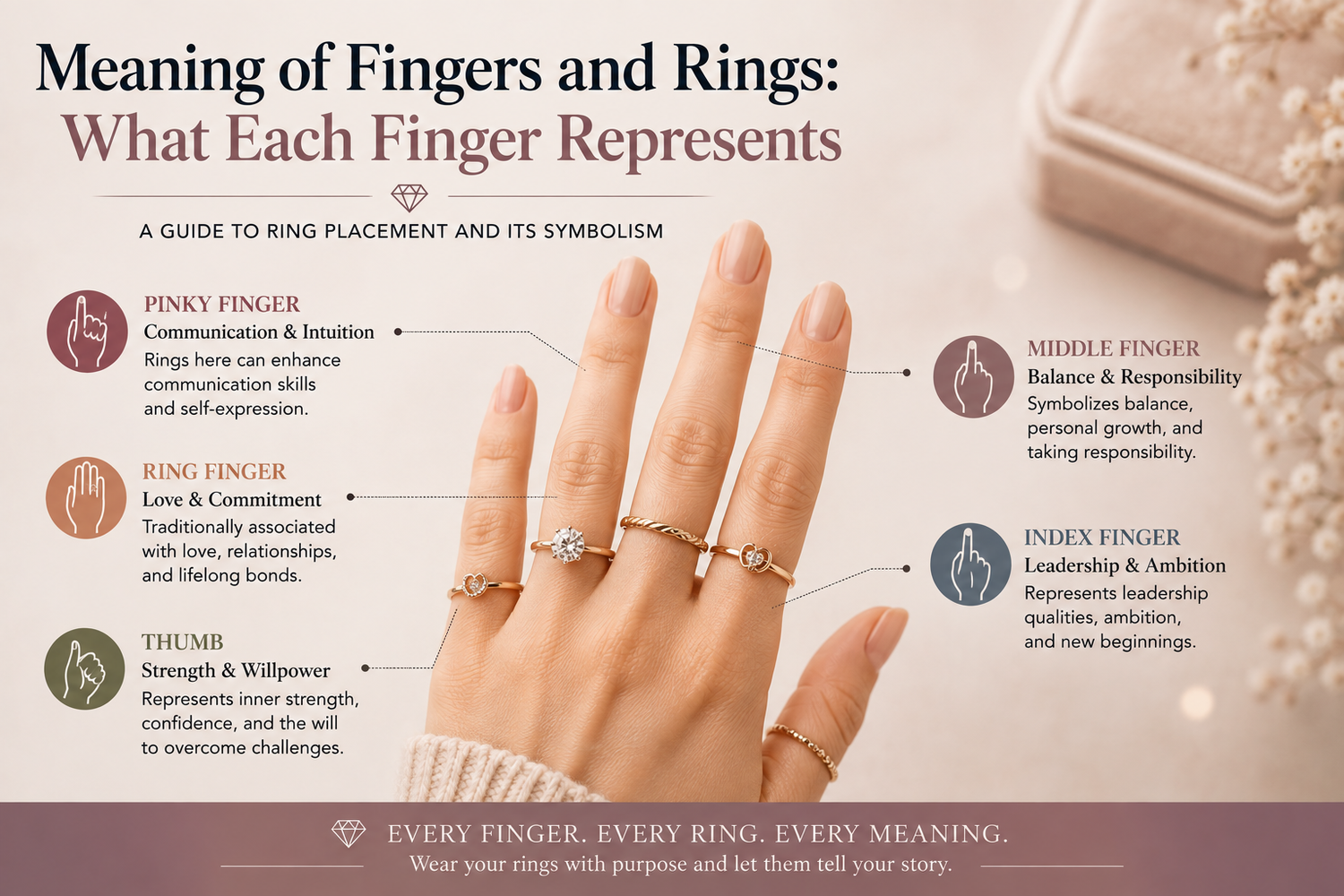
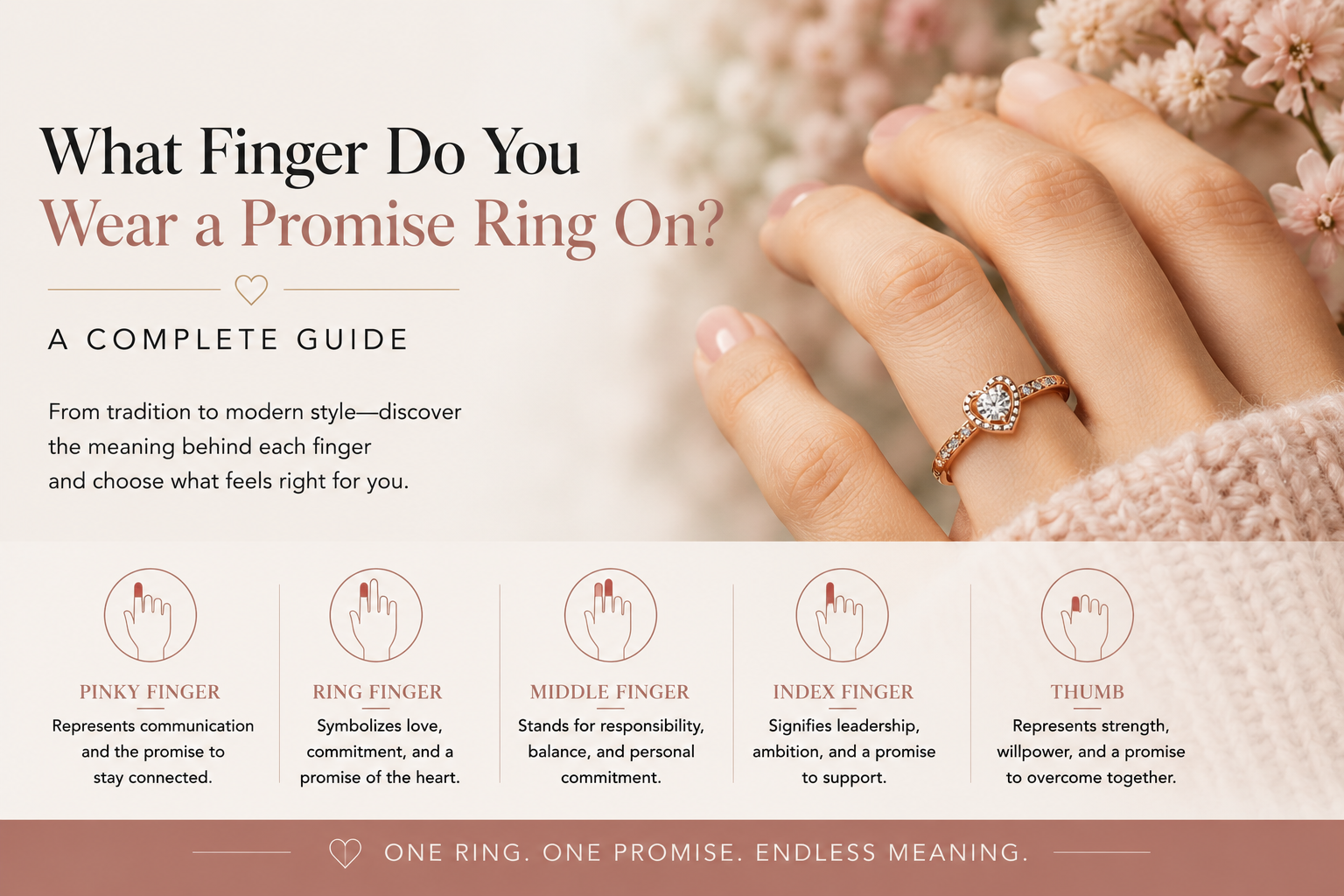
While among the least common fingers for rings in everyday wear, there exists no finger with such strong symbolism than the thumb. Traditionally, thumb rings have been used to denote power and wealth, and they have been worn by rulers, warriors, and archers because having a ring on the thumb was not only a fashion statement but had practical value as well for drawing a bowstring.
More recently, when a person decides to adorn himself with a thumb ring, he does so to make a bold statement about his confidence, individuality, or desire for freedom from conventional ideas. This is so because thumb rings stand out from other types of rings and do not convey the idea that someone is in a relationship.
Common meanings: Power, independence, confidence, self-expression.
The Index Finger

The index finger, which is the finger closest to the thumb, has been associated with authority, leadership, and even status for years. Historically, signet rings were worn by nobles, the church, and even government officials, who wore them to seal their official papers, and the signet ring was usually worn on the index finger.
Today, the index finger serves as the finger on which people prefer to wear a statement ring, especially one that makes an impact, as it tends to stand out. It is also considered a symbol of leadership and ambition.
Common meanings: Leadership, authority, ambition, personal power.
The Middle Finger

The middle finger is right at the heart of the hand, both literally and figuratively. As such, it has traditionally been associated with balance, responsibility, and identity. As compared to the ring finger and pinky finger, the middle finger does not have a significant meaning related to love and family in western culture. This makes the finger one of the best choices for those who wish to wear a symbolic ring, but not one that indicates they are in a relationship.
Such a ring may include promise rings worn as a symbol of personal commitment to a goal or principle.
Common meanings: Balance, personal identity, self-commitment, responsibility.
The Ring Finger

Of all fingers, the ring finger which is the fourth finger, adjacent to the little finger, is the most symbolic finger in Western culture because it has been associated with love and marriage.
Left Hand Ring Finger

In Western societies, the left ring finger is designated for an engagement and/or wedding ring. This practice dates back to the days when it was believed that there existed a "vein of love" (vena amoris), which connected the left ring finger directly to the heart. Although this physiological phenomenon does not exist, the custom has continued over the years to be associated with marital engagements and marriage.
This is also the finger many couples choose for a promise ring, particularly when it's meant to signal an intention toward future engagement.
Right Hand Ring Finger

However, in some cultures from Europe and Eastern Europe, such as in Germany, Russia, and India, the finger on which a wedding or engagement ring should be worn is the fourth finger of the right hand rather than the left hand. Even in other cases when the wearer does not belong to these specific traditions, many individuals opt for wearing their promise rings or fashion rings on their right ring finger just to avoid being associated with an engagement.
Common meanings: Love, commitment, marriage, partnership, romantic intention.
The Pinky Finger

The pinky, also known as the "little finger," has a rich history as far as symbolism goes. According to some beliefs, pinky rings (signet rings that have the family crest on them) used to be a way for noble families from Europe to demonstrate their lineage, heritage, and status. This is one reason why pinky rings continue to have a connection with the aesthetics of the old money world, business dynasties, and professional signet rings.
From the perspective of numerology and some spiritual schools of thought, the pinky finger is related to communication, intuition, and persuasion because it corresponds to Mercury in the system of finger associations with astrological signs.
The pinky also happens to be just a finger where a ring does not fit any other place.
Common meanings: Heritage, family legacy, communication, personal style, and (in some spiritual traditions) intuition.
Cultural Variations Worth Knowing
Though these definitions represent cultural norms in the West, the meaning of rings can vary greatly across different cultures and nations:
- India: The custom of wearing rings during wedding ceremonies is not typical in India, even though the practice of exchanging rings according to Western traditions becomes more widespread nowadays.
- China: According to certain traditional beliefs in China, different fingers correspond to members of one's family; hence the thumb corresponds to one's parents, index fingers - to brothers and sisters, middle fingers - to oneself, ring fingers - to spouses or partners, and pinky fingers - to children, as an explanation for the fact that the ring finger "won't be able to straighten" when the middle fingers of both hands are pressed against each other.
- Orthodox Christian nations (Russia, Greece, eastern Europe): Traditional use of the ring finger on the right hand for wedding and engagement rings.
- Ancient Rome and Egypt: Rings were worn on the index fingers to demonstrate status, before the romantic interpretation of the ring finger became popular.
Understanding these variations is especially useful for anyone gifting a ring across cultures, since a placement that reads as "engaged" in one country might carry no such meaning in another.
Choosing a Ring Finger With Intention
In choosing a ring, either for yourself or for someone else, especially if there is intention behind the choice, a few considerations may prove useful:
- For the expression of romantic commitment or a symbol of engagement: the left ring finger will still be recognized as the standard in most Western cultures.
- For a symbolic ring that is not intended to convey romance: a "neutral" placement will be achieved by the middle finger or the right hand.
- For making a statement with a ring: the thumb and index finger stand out visually more than other fingers.
- For rings that have been passed down through generations or family rings: the pinky finger keeps the old tradition of using the pinky finger.
Ultimately, while these traditions offer a helpful framework, the most important meaning behind any ring is the one you and the people in your life choose to give it. Whether you're wearing a custom-designed ring that reflects a very personal milestone, or simply love the way a piece looks on a particular finger, symbolism is a starting point — not a rulebook.
Frequently Asked Questions
Does it matter which finger you wear a ring on? Not necessarily in an official context, but finger positioning has very significant cultural connotations, especially the positioning of the left ring finger that has come to be associated with a relationship status of engagement/marriage.
What does a ring on the middle finger mean? Middle finger is generally regarded as a “neutral” finger, because unlike ring finger and pinky, it does not carry any romantic or family connotations, thus being very common for individual and symbolic rings not linked to relationships.
Why is the ring finger connected to love and marriage? This tradition goes back to the ancient concept of the vena amoris, which was believed to be the vein that led straight from the ring finger to the heart. Although scientifically inaccurate, the notion has continued through the ages as part of Western marriage traditions.
Is finger symbolism the same in every country? Incorrect. Though the left hand ring finger may be popular in the United States and other parts of Western Europe, there are certain nations like Germany, Russia and Greece that favor the right hand.
Final Thoughts
Each of the fingers also holds within it some personal history, whether it be the sense of strength and individuality that comes with the thumb or the history of love connected with the ring finger or even the familial background that lies with the pinky finger. While there is no longer such a traditional approach to choosing jewelry, knowing the history of each finger can provide an interesting background to your piece of jewelry. Whether you're choosing where to wear a natural diamond ring for the first time or gifting one to someone else, a little context on finger symbolism can help ensure the placement says exactly what you intend.
Incorrect. Though the left hand ring finger may be popular in the United States and other parts of Western Europe, there are certain nations like Germany, Russia and Greece that favor the right hand.


Leave a comment
This site is protected by hCaptcha and the hCaptcha Privacy Policy and Terms of Service apply.